Memorial Trip to Weimar and the Former Buchenwald Concentration Camp
“What Does History Have to Do With Me?”
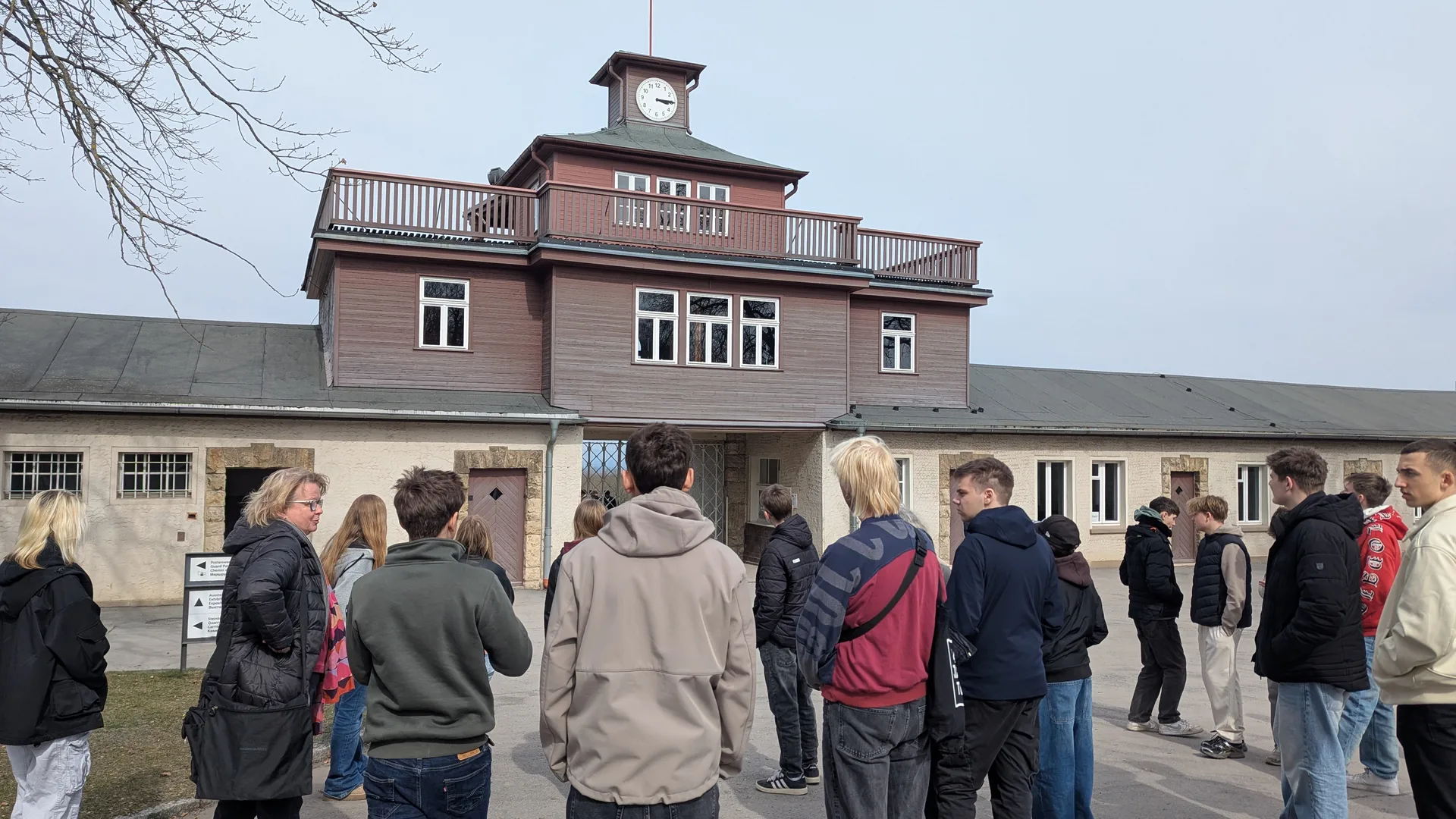
From March 23 to March 26, students from Realschule Grünstraße took part in a memorial trip to Weimar and the memorial site of the former Buchenwald concentration camp. The aim of the four-day excursion was to engage intensively with the history of National Socialism — especially persecution, forced labor, imprisonment in concentration camps, and the culture of remembrance both in Buchenwald and in present-day Weimar.
A total of 19 volunteer students from grades 9 and 10 participated in the trip. The group was accompanied by Mrs. Nockemann, Mr. Heilinger, Mr. Maack, and Dorian Klinner as an external guide. Before the trip, the students took part in a preparation day during which they deepened their historical knowledge and collaboratively planned creative projects that would later be developed on site.
Monday – Democracy, Weimar, and History
On Monday, the group traveled to Weimar using the Germany-wide public transport ticket and checked into the Art Hotel Weimar. Afterwards, Florian Klinner led a workshop on democracy, focusing on the questions:
What does democracy mean to us — and how can we protect it?
Following the workshop, the students explored the city of Weimar during a guided tour. They learned about the contrast between:
the humanistic legacy of Weimar Classicism
(Goethe, Schiller, Herder, and Wieland)and the later Nazi instrumentalization of Weimar
(for example Hitler appearing on the balcony of the Hotel Elephant)
Tuesday – Visiting the Buchenwald Memorial Site
On Tuesday, the group visited the Buchenwald Memorial Site for the first time. They walked up the historical memorial path of the former Buchenwald railway.
Along the way, individually designed memorial stones commemorate underage victims of Buchenwald and its satellite camps.
During a three-hour guided tour, the students gained profound insights into:
the organization of the concentration camp
the lives and suffering of the prisoners
the historical background of the site
The preserved buildings, eyewitness accounts, and historical documents made history tangible and left a lasting impression on many participants.
Afterwards, the students independently continued researching for their planned projects in the memorial site's permanent exhibition.
Wednesday – Forced Labor, Commemoration, and Remembrance Culture
Wednesday began with a visit to the Museum of Forced Labor under National Socialism in Weimar. There, the students deepened their understanding of the systematic exploitation of millions of people during the Nazi era.
Particularly moving were the individual stories of former forced laborers, many of whom received little or no compensation even decades after liberation.
Later, the group returned to Buchenwald for a joint memorial ceremony:
A moment of silence, remembrance, and reflection.
The students also explored different forms of remembrance culture, including:
the memorial monument built in East Germany in 1958
the open-air exhibition “The Witnesses”
Creative Project Work
Throughout the trip, the students reflected on their experiences through discussions and group work. Their impressions were then creatively processed in various projects.
Among the resulting works were:
a photo presentation titled
“Weimar Then and Now”several photo books featuring their own pictures and texts
a small illustrated “Pixi-style” book about an imprisoned father and his son
sketchbooks containing drawings and personal reflections
The projects will be presented at school on Friday, April 24.
Remembrance Education as Part of School Culture
The memorial trip clearly demonstrated how important it is to actively engage with the past. The combination of:
historical education
personal experience
and creative reflection
enabled the students to develop a meaningful and lasting connection to history.
The school plans to permanently establish the memorial trip as part of its educational travel program, allowing volunteer students from grades 9 and 10 to participate annually.
Remembrance education has long been an integral part of the school culture. Activities include:
cleaning memorial “Stolpersteine” on November 9
educational trips to Amsterdam
projects and ceremonies for Holocaust Remembrance Day
visits to the Ravensbrück memorial site
the exhibition “Library of Rescued Memories”
research projects on the silversmith Emmy Roth
The “Oath of Buchenwald” – and Our Present
The trip also changed the way students perceived current events and public remembrance.
For example, the students experienced the speech by Hape Kerkeling on the 81st anniversary of the liberation of Buchenwald very differently because they had visited the memorial site themselves only two weeks earlier.
At Buchenwald, the students also learned about the historical “Oath of Buchenwald”, written by survivors after liberation:
“The complete destruction of Nazism is our slogan.
The creation of a new world of peace and freedom is our ideal.”
Inspired by this, the students wrote letters to their future selves describing the values and causes they personally want to stand up for — in a way, their own:
“Oath of Buchenwald for the year 2026”
The letters will be mailed to them at the beginning of the next school year.
Acknowledgements
The memorial trip would not have been possible without the support of many organizations and institutions. We would like to sincerely thank:
Freizeitwerk Welper
the state of North Rhine-Westphalia
the Federal Child and Youth Plan
the Federal Ministry for Education, Family Affairs, Senior Citizens, Women and Youth
IBB Dortmund
the Bethe Foundation
the support association of Realschule Grünstraße
Ms. Nockemann, Mr. Heilinger, Mr. Maack